Vectors
The Vector2, Vector3 and Vector4 classes are used for 2, 3 and 4 dimensional vector representations. Vector instances are immutable; once a Vector has been instantiated its values cannot be changed.
val v2 = Vector2(1.0, 10.0)
Standard vectors
Vector2.ZERO    // (0, 0)
Vector2.UNIT_X  // (1, 0)
Vector2.UNIT_Y  // (0, 1)
Vector arithmetic
The vector classes have operator overloads for the most essential operations.
| left operand | operator | right operand | result |
|---|---|---|---|
VectorN | + | VectorN | addition of two vectors |
VectorN | - | VectorN | subtraction of two vectors |
VectorN | / | Double | scaled vector |
VectorN | * | Double | scaled vector |
VectorN | * | VectorN | component-wise multiplication (l.x * r.x, l.y * r.y) |
VectorN | / | VectorN | component-wise division (l.x / r.x, l.y / r.y) |
Some examples of vector arithmetic in practice
val a = Vector2(2.0, 4.0)
val b = Vector2(1.0, 3.0)
val sum = a + b
val diff = a - b
val scale = a * 2.0
val div = a / 2.0
val cwdiv = a / b
Vector properties
| property | description |
|---|---|
length | the length of the vector |
normalized | a normalized version of the vector |
Swizzling and sizing
Vector2 swizzles allow reordering of vector fields, this is a common pattern in GLSL
val v3 = Vector2(1.0, 2.0).vector3(z=0.0)
val v2 = Vector3(1.0, 2.0, 3.0).xy
Let/copy pattern
Here we present two patterns that make working with immutable Vector classes a bit more convenient.
The copy pattern (which comes from Vectors being Kotlin data classes)
val v = Vector2(1.0, 2.0)
val w = v.copy(y=5.0)      // (1.0, 5.0)
The let/copy pattern, which combines Kotlin’s let with copy
val v = someFunctionReturningAVector().let { it.copy(x=it.x + it.y) }
Mixing
Linear interpolation of vectors using mix()
val m = mix(v0, v1, f)
which is short-hand for
val m = v0 * (1.0 - f) + v1 * f
Randomness
Generating random vectors
val v2 = Vector2.uniform(-1.0, 1.0)
To generate random distributions of vectors see orx-noise.
Creating a Vector2 using Polar coordinates
Polar() has two arguments: angle in degrees and radius. We use .cartesian to convert it to a Vector2.
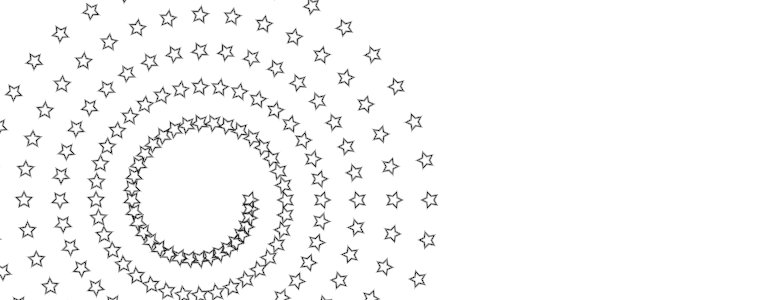
import org.openrndr.application
import org.openrndr.color.ColorRGBa
import org.openrndr.extra.composition.composition
import org.openrndr.extra.composition.drawComposition
import org.openrndr.extra.shapes.primitives.regularStar
import org.openrndr.math.Polar

fun main() = application {
    configure {
        width = 770
        height = 300
    }
    program {
        val myDesign = drawComposition {
            repeat(200) {
                val p = Polar(it * 10.0, 50.0 + it * 1.0).cartesian + 200.0
                contour(regularStar(5, 4.0, 8.0, p, it * 1.0))
            }
        }
        extend {
            drawer.clear(ColorRGBa.WHITE)
            drawer.composition(myDesign)
        }
    }
}
We can use Polar.fromVector(v2) to construct a Polar from an existing cartesian vector.